
Received 2026-04-16
Revised 2026-06-06
Accepted 2026-07-13
Prevalence of Campylobacter jejuni in Raw Poultry Meat and the Effect of Zataria multiflora Essential Oil on cdtA Gene Expression
Short title: Campylobacter in Poultry and Zataria Essential Oil Efffect
Hosein Razavian 1, Leila Golestan 2, Zohreh Mashak 3, Mohammad Ahmadi 1
1 Department of Food Hygiene, Am.C., Islamic Azad University, Amol, Iran
2 Department of Food Hygiene, SR.C., Islamic Azad University, Tehran, Iran
3 Department of Food Hygiene and Quality Control, Ka.c., Islamic Azad University, Karaj, Iran
|
Abstract Campylobacter jejuni (C. jejuni) is a major foodborne pathogen, and the expression of virulence genes such as cytolethal distending toxin subunit A (cdtA) plays an important role in its pathogenicity. This study determined the prevalence of C. jejuni in retail poultry products and evaluated the effect of Zataria multiflora (Z. multiflora) essential oil on cdtA gene expression. A total of 180 poultry samples, including chicken, quail, and ostrich, were examined using culture and PCR targeting the mapA gene. The antimicrobial activity of Z. multiflora essential oil was evaluated by the broth microdilution method to determine the minimum inhibitory concentration (MIC) and minimum bactericidal concentration (MBC). All 22 confirmed C. jejuni isolates (positive for cdtA) were exposed to isolate-specific MIC, 1/2 MIC, and 1/4 MIC concentrations. Relative cdtA expression was quantified by RT-qPCR using the 2−ΔΔCt method, and data were analyzed by one-way ANOVA followed by Tukey’s post hoc test. C. jejuni was detected in 22 of 180 samples (12.2%). MIC and MBC values ranged from 0.25–1.00 mg/mL and 0.50–2.00 mg/mL, respectively. Treatment with Z. multiflora essential oil significantly downregulated cdtA expression in a concentration-dependent manner. Relative expression decreased from 1.00 in the untreated control to 0.88, 0.77, and 0.63 following exposure to 1/4 MIC, 1/2 MIC, and MIC concentrations, respectively (P<0.05). Z. multiflora essential oil exhibited potent antibacterial activity against C. jejuni and significantly reduced cdtA gene expression, highlighting its potential as a natural antimicrobial for controlling this pathogen and attenuating its virulence.[GMJ.2026;15:e4282] DOI:4282 Keywords: Campylobacter Species; Campylobacter Jejuni; Prevalence; Poultry Meat |
|
GMJ Copyright© 2026, Galen Medical Journal. This is an open-access article distributed under the terms of the Creative Commons Attribution 4.0 International License (http://creativecommons.org/licenses/by/4.0/) Email:gmj@salviapub.com |

|
Correspondence to: Leila Golestan, Department of Food Hygiene, SR.C., Islamic Azad University, Tehran, Iran. Email: l.golestan57@iau.ir Telephone Number: 021 7700 9836 Email Address: abuhussam004@yahoo.com |
|
GMJ.2026;15:e4282 |
www.salviapub.com
|
Razavian H, et al |
Campylobacter in Poultry and Zataria Essential Oil Efffect |
|
2 |
GMJ.2026;15:e4282 www.salviapub.com |
Introduction
Poultry meat is a highly nutritious food and an important source of high-quality protein, vitamins, and essential minerals, making it particularly suitable for children and adolescents [1]. Owing to its affordability and nutritional value, poultry meat is consumed daily by millions of people worldwide [1, 2]. Consequently, maintaining its microbiological safety and hygienic quality is essential for preventing foodborne diseases [3].
Campylobacter species are among the most important zoonotic foodborne pathogens and commonly colonize the intestinal tract of poultry and other warm-blooded animals. These bacteria are the causative agents of campylobacteriosis, one of the leading bacterial foodborne diseases worldwide, which is primarily characterized by gastroenteritis, diarrhea, vomiting, and abdominal cramps and may occasionally result in death [4]. In addition to acute gastrointestinal illness, Campylobacter infection has been associated with several post-infectious complications, including reactive arthritis, irritable bowel syndrome, and Guillain–Barré syndrome [5]. Globally, campylobacteriosis is estimated to cause approximately 160 million cases of diarrhea and 40,000 deaths annually [6]. In the United States, the economic burden associated with Campylobacter infections, including healthcare costs, hospitalization, and productivity losses, has been estimated at approximately US dollars 1.5–7 billion per year [7].
Poultry serves as the principal reservoir of Campylobacter species because the avian intestinal temperature (approximately 42°C) provides optimal conditions for bacterial colonization and survival [8]. Among these species, Campylobacter jejuni (C. jejuni) is the predominant human pathogen and is responsible for the majority of bacterial gastroenteritis cases worldwide [9]. It has been estimated that more than 80% of human C. jejuni infections are associated with the consumption or handling of contaminated poultry meat and poultry products [10].
Given the high consumption of poultry meat and its recognized role as a major reservoir of Campylobacter jejuni, the present study was primarily designed to determine the prevalence of C. jejuni in raw chicken, quail, and ostrich meat samples. In addition, the study evaluated the effect of Zataria multiflora (Z. multiflora) essential oil on cytolethal distending toxin subunit A (cdtA) gene expression in the recovered C. jejuni isolates.
Materials and Methods
Ethical approval
The study protocol was reviewed and approved by the Ethics Committee of the Faculty of Veterinary Medicine, Ayatollah Amoli Branch, Islamic Azad University, Amol, Iran (Approval No. IR.IAU.AMOL.REC.1403.167). The study was conducted exclusively on poultry meat samples and did not involve human participants or live animals.
Preparation of Z. multiflora Essential Oil
The aerial parts of Z. multiflora Boiss. were collected from Amol, Mazandaran Province, Iran, during the flowering season. The plant material was authenticated by a botanist, and in the Herbarium of our institution. The collected plant material was shade-dried at room temperature and ground into a coarse powder. Essential oil was extracted by hydrodistillation using a Clevenger-type apparatus. Briefly, 100 g of the dried plant powder was mixed with 1 L of distilled water and hydrodistilled for 3 h. The obtained essential oil was dried over anhydrous sodium sulfate, transferred into sterile amber glass vials, and stored at 4°C until use. The extraction yield was approximately 1.8% (v/w, based on dry weight). Prior to antimicrobial assays, the essential oil was freshly diluted to the desired concentrations.
Sample collection
A cross-sectional study was conducted to determine the prevalence of C. jejuni in retail poultry products. A total of 180 poultry samples, comprising 60 chicken, 60 quail, and 60 ostrich samples, were collected from retail poultry outlets in Amol, Iran, between April 2022. Samples were obtained from retail poultry shops and supermarkets distributed across different areas of the city in order to include products from multiple commercial sources. During each sampling visit, poultry products available for human consumption were selected, with approximately equal numbers collected from each product category. Each sample represented an independent retail purchase. Only fresh chilled poultry products intended for human consumption were included in the study. Samples showing visible spoilage or damaged packaging were excluded. Immediately after purchase, samples were individually placed in sterile polyethylene bags, labeled, and transported to the laboratory in insulated containers containing ice packs, maintaining a temperature of approximately 4°C throughout transportation. All samples were processed microbiologically within 4 h of collection to minimize changes in bacterial viability. Microbiological isolation and identification of C. jejuni were subsequently performed according to the procedures described below.
Campylobacter isolation and species identification
Raw meat samples suspended in buffered peptone water were centrifuged at 4,000 rpm for 5 min, and the resulting pellet was resuspended in 30 mL of Preston enrichment broth base (HiMedia, India) supplemented with 5% defibrinated horse blood and Preston selective supplement (FD042; HiMedia, India). The cultures were incubated under microaerophilic conditions (5% O₂, 10% CO₂, and 85% N₂) using an AnaeroPak system (Mitsubishi, Japan) at 42°C for 24 h. Following enrichment, 100 μL of each culture was streaked onto blood agar base plates supplemented with selective supplement (FD006; HiMedia, India) and incubated under the same microaerophilic conditions at 42°C for an additional 48 h. Presumptive Campylobacter colonies, characterized by gray, flat, circular, and non-hemolytic morphology, were selected and subjected to Gram staining and standard biochemical characterization, including catalase, oxidase, nitrate reduction, and nalidixic acid susceptibility tests. Species-level identification was subsequently confirmed by polymerase chain reaction (PCR) targeting the Campylobacter 16S rRNA and C. jejuni mapA genes as described below.
PCR amplification
Following isolation, Campylobacter colonies were cultured in Bolton broth (Oxoid, UK) under the same incubation conditions described previously. Genomic DNA was extracted using a commercial DNA extraction kit (Thermo Scientific, USA) according to the manufacturer’s instructions. The integrity of the extracted DNA was evaluated by agarose gel electrophoresis, while DNA concentration and purity were determined using a NanoDrop spectrophotometer (Thermo Scientific, USA). PCR assays were performed using an Eppendorf thermal cycler (Germany) for molecular identification of Campylobacter spp. and C. jejuni. Amplification of the Campylobacter genus-specific 16S rRNA gene was carried out using the primers F: 5′-ATCTAATGGCTTAACCATTAAAC-3′ and R: 5′-GGACGGTAACTAGTTTAGTATT-3′, yielding an 857-bp amplicon. Identification of C. jejuni was performed by amplification of the mapA gene using the primers F: 5′-CTATTTTATTTTTGAGTGCTTGTG-3′ and R: 5′-GCTTTATTTGCCATTTGTTTTATTA-3′, producing a 589-bp PCR product. Each PCR reaction was carried out in a final volume of 50 μL containing 2.5 μL of template DNA, 5 μL of 10× PCR buffer, 1.25 U of Taq DNA polymerase, 200 μM of each dNTP, 1.5 mM MgCl₂, and 0.5 μM of each forward and reverse primer. The thermal cycling protocol consisted of an initial denaturation at 95°C for 10 min, followed by 35 cycles of denaturation at 95°C for 30 s, annealing at 59°C for 90 s, and extension at 72°C for 1 min, with a final extension at 72°C for 10 min. PCR products were analyzed by electrophoresis on 1.5% agarose gel prepared in 1× TBE buffer and stained with a nucleic acid staining dye. Electrophoresis was carried out at 100 V for approximately 45 min, and amplification products were visualized under ultraviolet illumination using a gel documentation system. Amplicon sizes were verified by comparison with a 100-bp DNA ladder and the expected product size for each target gene. To ensure the accuracy and reliability of PCR amplification, positive and negative controls were included in each PCR run. A previously confirmed C.r jejuni reference (ATCC 33560) isolate was used as the positive control, whereas nuclease-free water was used as the no-template negative control.
Determination of Minimum Inhibitory Concentration (MIC) and Minimum Bactericidal Concentration (MBC)
The antimicrobial activity of Z. multiflora essential oil against 22 C. jejuni isolates was evaluated using the broth microdilution method in sterile 96-well microplates according to the Clinical and Laboratory Standards Institute (CLSI) guidelines with minor modifications. Briefly, the essential oil was dissolved in dimethyl sulfoxide (DMSO) containing 0.5% (v/v) Tween 80 to improve its solubility, and two-fold serial dilutions ranging from 0.125 to 4 mg/mL were prepared in Mueller–Hinton broth supplemented with 5% lysed horse blood. Fresh bacterial suspensions were adjusted to approximately 5 × 10^5 CFU/mL, and 100 μL of each suspension was added to the wells containing equal volumes of the essential oil dilutions. Sterility control wells containing culture medium only, growth control wells containing bacterial suspension without essential oil, and solvent control wells containing the corresponding concentration of DMSO/Tween 80 were included in each experiment. The microplates were incubated under microaerophilic conditions at 42°C for 48 h. The MIC was defined as the lowest concentration of the essential oil that completely inhibited visible bacterial growth. To determine the MBC, 10 μL aliquots from wells showing no visible growth were inoculated onto Mueller–Hinton agar supplemented with 5% defibrinated sheep blood and incubated under microaerophilic conditions at 42°C for 48 h. The MBC was defined as the lowest concentration of the essential oil that resulted in no visible bacterial growth on the agar plates. All experiments were performed in triplicate, and the MIC and MBC values were recorded for each isolate.
Essential oil treatment and quantitative real-time PCR analysis
Following determination of the MIC of Z. multiflora essential oil against all cdtA-positive 22 C. jejuni isolates by the broth microdilution method, the effect of the essential oil on cdtA gene expression was evaluated using isolate-specific sub-inhibitory concentrations. Briefly, bacterial suspensions equivalent to 0.5 McFarland were prepared in 5 mL of nutrient broth and exposed to MIC, 1/2 MIC, and 1/4 MIC concentrations of the essential oil. Untreated bacterial cultures served as the negative control. Following incubation under microaerophilic conditions at 42°C for 24 h, bacterial cells were harvested for total RNA extraction. Total RNA was extracted using a commercial RNA extraction kit according to the manufacturer’s instructions. RNA concentration and purity were determined using a NanoDrop spectrophotometer by measuring absorbance at 260 and 280 nm, while RNA integrity was verified by electrophoresis on a 1% agarose gel. Complementary DNA (cDNA) was synthesized from purified RNA using the Omniscript Reverse Transcription Kit (Qiagen, Germany) according to the manufacturer’s protocol. Quantitative real-time PCR (qRT-PCR) was performed using SYBR Green 2× Master Mix on a Rotor-Gene 6000 real-time PCR system. Each 20 μL reaction contained 10 μL of 2× SYBR Green Master Mix, 1 μL of cDNA (1 μg/μL), 1 μL each of the forward and reverse primers (0.2 μM each), and 7 μL of diethyl pyrocarbonate (DEPC)-treated water. Amplification was carried out under the following cycling conditions: an initial denaturation at 94°C for 10 min, followed by 30 cycles of denaturation at 94°C for 15 s, annealing at 59°C for 30 s, and extension at 72°C for 25 s. The cdtA gene was amplified using the primers F: 5′-TTTTGAAAATCGCCCTGCGG-3′ and R: 5′-GCTCCGCTAGGGCCTAAAAT-3′, producing a 57-bp amplicon. The 16S rRNA gene served as the endogenous reference and was amplified using the primers F: 5′-TGAGGGAGAGGCAGATGGAA-3′ and R: 5′-TCGCCTTCGCAATGGGTATT-3′, generating an 87-bp product. All reactions were performed in triplicate. Primer specificity was confirmed by melt-curve analysis, which demonstrated a single sharp peak for each primer pair without evidence of nonspecific amplification or primer-dimer formation. The primer sequences were adopted from previously published validated studies. A no-template control (NTC) was included in each qRT-PCR run to monitor reagent contamination, and no amplification was observed in these controls. In addition, no-reverse-transcription (no-RT) controls were included to verify the absence of genomic DNA contamination in the RNA samples. Relative cdtA gene expression was normalized against the 16S rRNA housekeeping gene and calculated using the 2−ΔΔCt method.
Statistical analysis
Statistical analyses were performed using IBM SPSS Statistics. The prevalence of C. jejuni was calculated as the proportion of positive samples among the total number of samples examined. Exact 95% confidence intervals (Clopper–Pearson method) were calculated for all prevalence estimates. Associations between poultry meat type and the prevalence of C. jejuni were evaluated using Fisher’s exact test because of the relatively small number of positive samples in each subgroup. Exact two-tailed P-values were reported. Relative gene expression levels were expressed as mean ± standard deviation (SD) from three independent experiments. Differences in gene expression among treatment groups were assessed using one-way analysis of variance (ANOVA), followed by Tukey’s post hoc multiple-comparison test. A two-tailed P-value < 0.05 was considered statistically significant.
Results
Campylobacter contamination rate
A total of 180 poultry meat samples, including chicken (n = 60), quail (n = 60), and ostrich (n = 60), were examined for the presence of C. jejuni. Overall, C. jejuni was detected in 22 (12.22%) samples. Among the poultry species, the highest prevalence was observed in ostrich meat (9/60, 15.00%), followed by chicken meat (8/60, 13.33%), whereas quail meat exhibited the lowest prevalence (5/60, 8.33%) (Table-1). Representative PCR amplification of the mapA gene used for molecular confirmation of C. jejuni isolates is shown in Figure-1. Fisher’s exact test demonstrated no statistically significant association between poultry meat type and the prevalence of C. jejuni contamination (P=0.65).
Antimicrobial activity of Z. multiflora essential oil
The antimicrobial activity of Z. multiflora essential oil against the 22 C. jejuni isolates was evaluated using the broth microdilution method. The MIC values ranged from 0.25 to 1.00 mg/mL, whereas the corresponding MBC values ranged from 0.50 to 2.00 mg/mL. As presented in Table-2, the most frequently observed MIC was 0.50 mg/mL (40.91%), followed by 0.25 mg/mL (36.36%), while only 22.73% of isolates exhibited an MIC of 1.00 mg/mL. The corresponding MBC values were generally one two-fold dilution higher than the MIC values, confirming the bactericidal activity of the essential oil against all tested isolates.
Effect of Z. multiflora essential oil on cdtA gene expression
Relative cdtA gene expression was quantified by qRT-PCR using the 2−ΔΔCt method after normalization against the 16S rRNA housekeeping gene. Gene-expression values are presented as the mean ± standard deviation (SD) of three independent biological experiments, each performed in triplicate. As shown in Table-3 and Figure-2, exposure of all 22 C. jejuni isolates to Z. multiflora essential oil resulted in a concentration-dependent reduction in cdtA expression. Compared with the untreated control (1.00 ± 0.00), treatment with 1/4 MIC reduced relative gene expression to 0.88 ± 0.05 (P = 0.01), while 1/2 MIC further decreased expression to 0.77 ± 0.04 (P = 0.009). The greatest inhibitory effect was observed at the MIC concentration, where relative cdtA expression declined to 0.63 ± 0.03 (P<0.001). One-way ANOVA followed by Tukey’s multiple-comparison test confirmed that the reduction in cdtA expression was statistically significant and concentration dependent.
Expression levels were normalized to the 16S rRNA reference gene and calculated using the 2−ΔΔCt method. Data are presented as mean ± SD from three independent biological experiments performed in triplicate. Statistical significance was determined using one-way ANOVA followed by Tukey’s multiple-comparison test (*P<0.05, **P<0.01, ***P<0.001).
Discussion
C. jejuni remains one of the most important foodborne pathogens associated with poultry products and continues to represent a major public health concern worldwide because of its ability to cause gastroenteritis and post-infectious complications [11, 12, 13]. In the present study, C. jejuni was detected in 12.22% of retail poultry meat samples. Although the highest prevalence was observed in ostrich meat, no statistically significant difference was found among poultry types (P>0.05), indicating that contamination may occur across different poultry products irrespective of the animal species.
The prevalence observed in the present study was lower than that reported in several previous investigations conducted in different countries. Reported contamination rates have ranged from 21.40% in quail meat [14] to 77.50% in duck meat [15], while prevalence values of 24.63% in ostrich meat [16], 49.30% in turkey meat [17], 25.40% in retail chicken meat in the United States [18], 32.80% in West Africa [19], and 28.90% in Iran [20] have also been described. Likewise, Hadiyan et al. [21], Mousavinafchi et al. [22], and Sabzmeydani et al. [23] reported substantially higher prevalence rates in poultry meat collected from different regions. These discrepancies among studies are expected and may be explained by differences in geographical location, sampling strategy, slaughterhouse hygiene, season of sampling, poultry production systems, and microbiological detection methods [11, 12, 13]. Therefore, direct comparison of prevalence values between studies should be interpreted with caution.
In addition to determining prevalence, the present study evaluated the antibacterial activity of Z. multiflora essential oil against all recovered C. jejuni isolates. The essential oil exhibited clear inhibitory activity, with MIC values ranging from 0.25 to 1.00 mg/mL and MBC values ranging from 0.50 to 2.00 mg/mL. Furthermore, for all isolates, the MBC was only one two-fold dilution higher than the corresponding MIC, indicating that the essential oil exerted bactericidal activity against C. jejuni. These findings are consistent with previous reports demonstrating that plant-derived essential oils possess broad-spectrum antimicrobial activity against foodborne pathogens through disruption of membrane integrity, increased membrane permeability, leakage of intracellular constituents, and impairment of essential metabolic processes [24, 25].
A major finding of the present study is the significant reduction in cdtA gene expression following exposure to isolate-specific sub-inhibitory concentrations of Z. multiflora essential oil. Relative cdtA expression decreased progressively from 1.00 in the untreated control to 0.88, 0.77, and 0.63 after treatment with 1/4 MIC, 1/2 MIC, and MIC concentrations, respectively, demonstrating a statistically significant concentration-dependent response. Unlike conventional antimicrobial susceptibility testing, which evaluates bacterial growth inhibition, analysis of virulence-associated gene expression provides additional insight into the ability of antimicrobial agents to attenuate bacterial pathogenicity without necessarily eliminating bacterial cells [26, 27]. Since cdtA constitutes one component of the cytolethal distending toxin (CDT) operon, which plays an essential role in adhesion, toxin delivery, and host cell damage during C. jejuni infection, suppression of its expression may indicate reduced virulence potential under laboratory conditions [28].
The concentration-dependent reduction observed in the present study also suggests that the biological activity of Z. multiflora essential oil extends beyond direct growth inhibition. Essential oils are complex mixtures of phenolic compounds and terpenoids capable of influencing multiple cellular targets simultaneously, including membrane structure, energy metabolism, enzyme activity, quorum sensing, and transcriptional regulation [24, 25, 29]. Such multitarget activity may explain why exposure to sub-inhibitory concentrations was sufficient to significantly decrease cdtA expression. Nevertheless, the precise molecular mechanisms responsible for this transcriptional modulation remain unclear and require further investigation.
The present study has several limitations that should be acknowledged. First, only 22 C. jejuni isolates were recovered, which may limit the generalizability of the findings. Second, only C. jejuni was investigated, whereas other clinically relevant campylobacter species were not included. Third, although the antimicrobial activity of Z. multiflora essential oil was evaluated by MIC and MBC determination, its chemical composition was not characterized; therefore, the contribution of individual bioactive constituents to the observed antibacterial and antivirulence effects could not be determined. In addition, only cdtA gene expression was evaluated, while protein expression and toxin production were not assessed to confirm whether transcriptional changes translated into functional effects. Furthermore, all experiments were performed under in vitro laboratory conditions, and the antimicrobial efficacy of the essential oil was not validated in real food matrices or food preservation systems. Consequently, factors such as stability, interactions with food components, sensory effects, migration behavior, cytotoxicity, and consumer safety were beyond the scope of the present study. Therefore, the present findings should be regarded as preliminary evidence of antibacterial activity and cdtA gene modulation under laboratory conditions. Future studies should include larger collections of isolates, comprehensive chemical characterization of the essential oil, functional toxin assays, and validation in food models before practical applications can be considered.
Conclusion
The present study demonstrated that C. jejuni is present in retail poultry meat, confirming its continued importance as a foodborne pathogen. Z. multiflora essential oil exhibited notable antibacterial activity against all recovered isolates, with MIC values ranging from 0.25 to 1.00 mg/mL and MBC values ranging from 0.50 to 2.00 mg/mL. In addition, exposure to sub-inhibitory concentrations of the essential oil resulted in a significant concentration-dependent reduction in cdtA gene expression, suggesting a potential antivirulence effect under in vitro conditions. These findings indicate that Z. multiflora essential oil may modulate both bacterial growth and the expression of a key virulence-associated gene in C. jejuni. However, because the study was conducted exclusively under laboratory conditions, the results should be considered preliminary. Further investigations are required to characterize the chemical composition of the essential oil, validate its efficacy in food matrices, evaluate toxin production and protein expression, and assess its safety and practical applicability before food-related applications can be proposed.
Acknowledgment
The authors gratefully acknowledge the affiliated institutions for their valuable support and considerable efforts throughout the course of this study.
Conflict of Interest
The authors declare no conflict of interest.
AI Disclosure Statement
During the preparation of this manuscript, the authors used ChatGPT, OpenAI company for language editing, grammar improvement, and liboberry.com for reference management. After its use, the authors thoroughly reviewed, verified, and revised all AI-assisted content to ensure accuracy and originality. The authors take full responsibility for the integrity and final content of the published article.
|
Campylobacter in Poultry and Zataria Essential Oil Efffect |
Razavian H, et al |
|
GMJ.2026;15:e4282 www.salviapub.com |
3 |
|
Al-Hakami H |
Campylobacter in Poultry and Zataria Essential Oil Efffect |
|
4 |
GMJ.2026;15:e4282 www.salviapub.com |
|
Campylobacter in Poultry and Zataria Essential Oil Efffect? |
Al-Hakami H |
|
GMJ.2026;15:e4282 www.salviapub.com |
5 |
Table 1. Distribution of C. jejuni among the examined samples.
|
Poultry meat type |
No. of samples examined |
Positive for C. jejuni, n (%) |
95% CI |
|
Chicken |
60 |
8 (13.33) |
5.9–24.6 |
|
Quail |
60 |
5 (8.33) |
2.8–18.4 |
|
Ostrich |
60 |
9 (15) |
7.1–26.6 |
|
Total |
180 |
22 (12.22) |
7.8–17.9 |
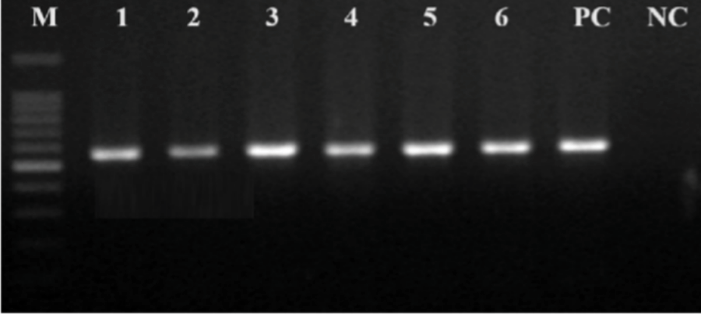
Figure 1. Representative agarose gel electrophoresis of PCR products for detection of the mapA gene in C. jejuni. M: 100-bp DNA ladder; lanes 1–6: positive isolates (589 bp); PC: positive control; NC: negative control.
|
Al-Hakami H |
Campylobacter in Poultry and Zataria Essential Oil Efffect |
|
6 |
GMJ.2026;15:e4282 www.salviapub.com |
Table 2. Distribution of MIC and MBC values of Z. multiflora essential oil against C. jejuni isolates.
|
MIC (mg/mL) |
MBC (mg/mL) |
Number of isolates (n) |
Percentage (%) |
|
0.25 |
0.50 |
8 |
36.36 |
|
0.50 |
1.00 |
9 |
40.91 |
|
1.00 |
2.00 |
5 |
22.73 |
|
Total |
- |
22 |
100 |
Table 3. Expression of cdtA gene in exposure to Z. multiflora essential oil.
|
Treatment |
Relative cdtA expression (mean ± SD) |
P-value vs. control |
|
Control |
1.00 ± 0.00 |
- |
|
1/4 MIC |
0.88 ± 0.05 |
0.041 |
|
1/2 MIC |
0.77 ± 0.04 |
0.009 |
|
MIC |
0.63 ± 0.03 |
<0.001 |
|
Campylobacter in Poultry and Zataria Essential Oil Efffect? |
Al-Hakami H |
|
GMJ.2026;15:e4282 www.salviapub.com |
7 |
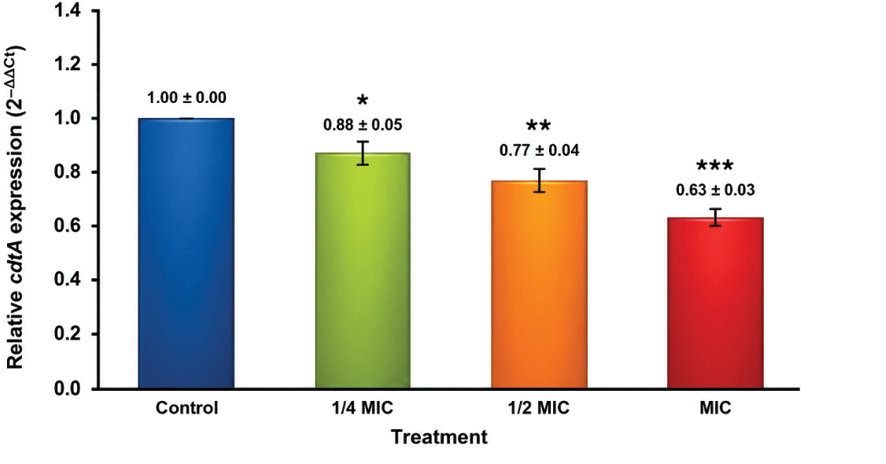
Figure 2. Relative expression of the cdtA gene in C. jejuni following exposure to isolate-specific MIC, 1/2 MIC, and 1/4 MIC concentrations of Z. multiflora essential oil
|
Al-Hakami H |
Campylobacter in Poultry and Zataria Essential Oil Efffect |
|
8 |
GMJ.2026;15:e4282 www.salviapub.com |
|
Campylobacter in Poultry and Zataria Essential Oil Efffect |
Al-Hakami H |
|
GMJ.2026;15:e4282 www.salviapub.com |
9 |
|
References |
|
Al-Hakami H |
Campylobacter in Poultry and Zataria Essential Oil Efffect |
|
10 |
GMJ.2026;15:e4282 www.salviapub.com |