
Knowledge, Attitudes, and Preventive Practices Regarding Thyroid Disorders During Pregnancy: A Nationwide Online Cross-Sectional Study
DOI:
https://doi.org/10.31661/gmj.v15i.4154Keywords:
Thyroid Disorders, Pregnancy, Hypothyroidism, Hyperthyroidism, Knowledge, Attitudes, Saudi ArabiaAbstract
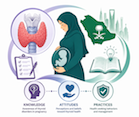
Background: Thyroid dysfunction during pregnancy is an important endocrine concern because untreated disease may adversely affect maternal health, pregnancy outcomes, and fetal neurodevelopment. Public awareness is particularly relevant in Saudi Arabia, where historical iodine deficiency, regional variation in dietary iodine intake, and differences in health literacy may influence preventive behaviors. This study assessed knowledge, attitudes, and preventive practices regarding thyroid disorders during pregnancy among Saudi adults of reproductive age. Materials and Methods: A nationwide online cross-sectional survey was conducted among 1,053 Saudi adults aged 18-45 years from the five major geographical regions of Saudi Arabia. Participants completed a structured self-administered questionnaire assessing sociodemographic characteristics, knowledge of thyroid disorders in pregnancy, attitudes toward screening and treatment, preventive practices, and sources of health information. Knowledge, attitude, and practice scores were summarized using descriptive statistics. Group differences were examined using independent-samples t-tests or one-way analysis of variance, as appropriate. Results: The mean knowledge score was moderate at 5.9 ± 2.4 out of 10. Although most participants recognized that thyroid disorders can be diagnosed using blood tests (84.2%) and may affect fetal brain development (76.1%), only 52.1% knew that thyroid disorders during pregnancy may be asymptomatic. Attitudes were generally favorable, with a mean score of 26.9 ± 4.5 out of 35; 82.9% agreed or strongly agreed that thyroid screening is important in prenatal care, and 96.0% recognized the importance of management for fetal health. Preventive practices were less optimal, with a mean score of 5.4 ± 2.3 out of 10. Only 44.1% had previously undergone thyroid function testing, and 30.1% regularly consumed iodine-rich foods. Conclusion: Saudi adults of reproductive age demonstrated favorable attitudes but only moderate knowledge and suboptimal preventive practices regarding thyroid disorders during pregnancy. These findings support targeted public health education, improved preconception counseling
References
Krassas GE, Poppe K, Glinoer D. Thyroid function and human reproductive health. Endocr Rev 2010;31(5):702-55. doi:10.1210/er.2009-0041
Glinoer D. The regulation of thyroid function in pregnancy: pathways of endocrine adaptation from physiology to pathology. Endocr Rev 1997;18(3):404-33. doi:10.1210/edrv.18.3.0300
Teng W, Shan Z, Patil-Sisodia K, Cooper DS. Hypothyroidism in pregnancy. Lancet Diabetes Endocrinol 2013;1(3):228-37. doi:10.1016/S2213-8587(13)70109-8
Taylor PN, Lazarus JH. Hypothyroidism in Pregnancy. Endocrinol Metab Clin North Am 2019;48(3):547-56. doi:10.1016/j.ecl.2019.05.010
Morreale de Escobar G, Obregon MJ, Escobar del Rey F. Role of thyroid hormone during early brain development. Eur J Endocrinol 2004;151 Suppl 3:U25-U37. doi:10.1530/eje.0.151u025
Casey BM, Dashe JS, Wells CE, McIntire D, Leveno KJ, Cunningham FG. Subclinical hypothyroidism and pregnancy outcomes. Obstet Gynecol 2005;105(2):239-45.
Haddow JE, Palomaki GE, Allan WC, Williams JR, Knight GJ, Gagnon J, et al. Maternal thyroid deficiency during pregnancy and subsequent neuropsychological development of the child. N Engl J Med 1999;341(8):549-55.
Sheffield JS, Cunningham FG. Thyrotoxicosis and heart failure that complicate pregnancy. Am J Obstet Gynecol 2004;190(1):211-7.
Alexander EK, Pearce EN, Brent GA, Brown RS, Chen H, Dosiou C, et al. 2017 Guidelines of the American Thyroid Association for the Diagnosis and Management of Thyroid Disease During Pregnancy and the Postpartum. Thyroid 2017;27(3):315-89.
Al-Nuaim AR, Al-Mazrou Y, Kamel M, Al-Attas O, Al-Daghari N, Sulimani R. Iodine deficiency in Saudi Arabia. Ann Saudi Med 1997;17(3):293-7. doi:10.5144/0256-4947.1997.293
Al-Harthi S, Al-Harbi K, Al-Amer O. The Association Between Consanguinity and Autoimmune Thyroid Diseases in a Saudi Population. J Clin Med Res 2021;13(1):38-44.
Al-Abdi SY, Al-Salloum AA, Al-Omar AA. Maternal and neonatal outcomes in pregnant women with subclinical hypothyroidism: a cross-sectional study from a tertiary care center in Saudi Arabia. Saudi Med J 2020;41(5):489-95.
Rinaldi MD, Stagnaro-Green AS. Thyroid disease and pregnancy: degrees of knowledge. Thyroid 2007;17(8):747-53. doi:10.1089/thy.2007.0080
Han L, Jin J, Xu J, Wang H, Qin A, Chen J. Knowledge, Attitude and Practice Regarding Thyroid Disorders in Pregnant Women: A Cross-Sectional Study in Guangdong, China. Int J Womens Health 2025;17:2001-13. Published 2025 Jul 10. doi:10.2147/IJWH.S530418
Askari S, Abdi H, Ahmadi S, Bahadoran Z, Amouzegar A. Knowledge of Thyroid Disorders during Pregnancy among General Practitioners in Iran. Int J Endocrinol Metab 2017;15(3):e55450. Published 2017 Jun 21. doi:10.5812/ijem.55450
Kut A, Kalli H, Anil C, Mousa U, Gursoy A. Knowledge, attitudes and behaviors of physicians towards thyroid disorders and iodine requirements in pregnancy. J Endocrinol Invest 2015;38(10):1057-64. doi:10.1007/s40618-015-0275-x
Toloza FJK, Theriot SE, Singh Ospina NM, Nooruddin S, Keathley B, Johnson SM, et al. Knowledge, Attitudes, Beliefs, and Treatment Burden Related to the Use of Levothyroxine in Hypothyroid Pregnant Women in the United States. Thyroid. 2021;31(4):669-77. doi:10.1089/thy.2020.0629
Al Otaibi S, Al Harbi M, Al Kahmoas A, Al Qhatani F, Al Mutairi F, Al Mutairi T, et al. General breast cancer awareness among women in Riyadh city. Asian Pacific journal of cancer prevention: APJCP 2017;18(1):159.
Published
How to Cite
Issue
Section
License
Copyright (c) 2026 Galen Medical Journal

This work is licensed under a Creative Commons Attribution 4.0 International License.