
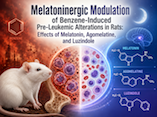
Melatoninergic Modulation of Benzene-Induced Pre-Leukemic Alterations in Rats: Effects of Melatonin, Agomelatine, and Luzindole
-
DOI:
https://doi.org/10.31661/gmj.v15i.4245Keywords:
Benzene-Induced Pre-Leukemia, Melatonin, Agomelatine, Oxidative Stress, Bone Marrow Micronucleus, Activin A, FollistatinAbstract
Background: Benzene is a well-established leukemogen associated with hematotoxicity, oxidative injury, inflammation, and genotoxic alterations, particularly in relation to acute myeloid leukemia (AML). Melatonin has antioxidant and anti-inflammatory properties that may exert protective effects against benzene-induced pre-leukemic alterations.
Materials and Methods: This study evaluated melatoninergic modulation in a benzene-induced pre-leukemic rat model. Rats were assigned to five groups (n=8): control, benzene-only, benzene + melatonin (10 mg/kg), benzene + agomelatine (10 mg/kg), and benzene + melatonin + luzindole (0.2 mg/kg). Benzene was administered intravenously as a benzene:2-propanol: distilled water mixture (1:5:5, v/v/v) every 48 h for 4 weeks. Melatonin and agomelatine were administered orally once daily, while luzindole was used to assess melatonin receptor blockade. Hematological indices, leukocyte ratios, platelet parameters, bone marrow micronucleus endpoints, Activin A, Follistatin, MDA, 8-OHdG, CAT, and SOD were assessed.
Results: Benzene exposure induced hematological disruption, altered leukocyte and platelet-related indices, increased micronucleus formation, and disturbed oxidative stress markers. Melatonin and agomelatine attenuated several benzene-induced alterations, including changes in erythropoietic indices, micronucleus frequency, leukocyte distribution, platelet-related parameters, MDA, and CAT activity. Luzindole partially reduced selected protective effects, suggesting that some responses may involve melatonin receptor-related pathways. However, inconsistent Activin A trends and unchanged Follistatin levels require cautious interpretation.
Conclusion: Melatonin and agomelatine attenuated several hematological, genotoxic, and oxidative alterations in benzene-exposed rats. Luzindole partially modified these effects, suggesting possible melatonin receptor involvement alongside non-receptor antioxidant and anti-inflammatory actions.
References
Lu PC, Shahbaz S, Winn LM. Benzene and its effects on cell signaling pathways related to hematopoiesis and leukemia. J Appl Toxicol. 2020;40(8):1018-1032.
https://doi.org/10.1002/jat.3961
PMid:32112456
Yusoff NA, Abd Hamid Z, Budin SB, Taib IS. Linking benzene, in utero carcinogenicity and fetal hematopoietic stem cell niches: a mechanistic review. Int J Mol Sci. 2023;24(7):6335.
https://doi.org/10.3390/ijms24076335
PMid:37047305 PMCid:PMC10094243
Ben Dhia O, Lasram MM, Harizi N, Doghri R, Charfi L, Souai N, et al. Kefir milk alleviates benzene-induced immunotoxicity and hematotoxicity in rats. Environ Sci Pollut Res Int. 2021;28(31):42230-42242.
https://doi.org/10.1007/s11356-021-13569-3
PMid:33797720
Elazab MFA, Elbaiomy AE, Ahmed MS, Alsharif KF, Dahran N, Elmahallawy EK, et al. Ameliorative effects of bovine lactoferrin on benzene-induced hematotoxicity in albino rats. Front Vet Sci. 2022;9:907580.
https://doi.org/10.3389/fvets.2022.907580
PMid:35812844 PMCid:PMC9257330
Demsia G, Vlastos D, Matthopoulos DP. Effect of 910-MHz electromagnetic field on rat bone marrow.ScientificWorldJournal. 2004;4:48-54.
https://doi.org/10.1100/tsw.2004.178
PMid:15517102 PMCid:PMC5956425
Dewi R, Hamid ZA, Rajab NF, Shuib S, Razak SA. Genetic, epigenetic, and lineage-directed mechanisms in benzene-induced malignancies and hematotoxicity targeting hematopoietic stem cells niche. Hum Exp Toxicol. 2020;39(5):577-595.
https://doi.org/10.1177/0960327119895570
PMid:31884827
Sun R, Liu M, Xu K, Pu Y, Huang J, Liu J, et al. Ferroptosis is involved in benzene-induced hematotoxicity in mice via iron metabolism, oxidative stress and NRF2 signaling pathway. Chem Biol Interact. 2022;362:110004.
https://doi.org/10.1016/j.cbi.2022.110004
PMid:35661779
Jelic MD, Mandic AD, Maricic SM, Srdjenovic BU. Oxidative stress and its role in cancer. J Cancer Res Ther. 2021;17(1):22-28.
https://doi.org/10.4103/jcrt.JCRT_862_16
PMid:33723127 PMCid:PMC13235539
Tejchman K, Kotfis K, Sieńko J. Biomarkers and mechanisms of oxidative stress: last 20 years of research with an emphasis on kidney damage and renal transplantation. Int J Mol Sci. 2021;22(15):8010.
https://doi.org/10.3390/ijms22158010
PMid:34360776 PMCid:PMC8347360
Cho JH, Bhutani S, Kim CH, Irwin MR. anti-inflammatory effects of melatonin: a systematic review and meta-analysis of clinical trials. Brain Behav Immun. 2021;93:245-253.
https://doi.org/10.1016/j.bbi.2021.01.034
PMid:33581247 PMCid:PMC7979486
Talib WH, Alsayed AR, Abuawad A, Daoud S, Mahmod AI. Melatonin in cancer treatment: current knowledge and future opportunities. Molecules. 2021;26(9):2506
https://doi.org/10.3390/molecules26092506
PMid:33923028 PMCid:PMC8123278
Mousavi SM, Etemad L, Yari D, Hashemi M, Salmasi Z. Evaluation of melatonin and its nanostructures effects on skin disorders focused on wound healing. Mini Rev Med Chem. 2024;24(20):1856-1881.
https://doi.org/10.2174/0113895575299255240422055203
PMid:38685805
Hattori A, Suzuki N. Receptor-mediated and receptor-independent actions of melatonin in vertebrates. Zool Sci. 2024;41(1):105-116
https://doi.org/10.2108/zs230057
PMid:38587523
Yi YJ, Tang H, Pi PL, Zhang HW, Du SY, Ge WY, et al. Melatonin in cancer biology: pathways, derivatives, and the promise of targeted delivery. Drug Metab Rev. 2024;56(1):62-79.
https://doi.org/10.1080/03602532.2024.2305764
PMid:38226647
Reiter RJ, Sharma R, Ma Q, Domínguez-Rodríguez A, Marik PE, Abreu-Gonzalez P. Melatonin inhibits COVID-19-induced cytokine storm by reversing aerobic glycolysis in immune cells: a mechanistic analysis. Med Drug Discov. 2020;6:100044.
https://doi.org/10.1016/j.medidd.2020.100044
PMid:32395713 PMCid:PMC7211589
Monteiro KKAC, Shiroma ME, Damous LL, Simões MJ, Simões RS, Cipolla-Neto J, et al. Antioxidant actions of melatonin: a systematic review of animal studies. Antioxidants. 2024;13(4):439.
https://doi.org/10.3390/antiox13040439
PMid:38671887 PMCid:PMC11047453
Rohilla S, Singh M, Priya S, Almalki WH, Haniffa SM, Subramaniyan V, et al. Exploring the mechanical perspective of a new anti-tumor agent: melatonin. J Environ Pathol Toxicol Oncol. 2023;42(1):1-18
https://doi.org/10.1615/JEnvironPatholToxicolOncol.2022042088
PMid:36734949
Megerian MF, Kim JS, Badreddine J, Hong SH, Ponsky LE, Shin JI, Abou Ghayda R. Melatonin and prostate cancer: anti-tumor roles and therapeutic application. Aging Dis. 2023;14(3):840-853.
https://doi.org/10.14336/AD.2022.1010
PMid:37191417 PMCid:PMC10187692
He ABL, Ng NKL, Cher CY, To AW, Zhang C, Lam SS, Leung A. Dysregulation of follistatin promotes leukemogenesis in acute myeloid leukemia. Blood. 2017;130(Suppl 1):4982.
Ries A, Schelch K, Falch D, Pany L, Hoda MA, Grusch M. Activin A: an emerging target for improving cancer treatment? Expert Opin Ther Targets. 2020;24(10):985-996.
https://doi.org/10.1080/14728222.2020.1799350
PMid:32700590
Li F, Long Y, Yu X, Tong Y, Gong L. Different immunoregulation roles of activin A compared with TGF-β. Front Immunol. 2022;13:921366.
https://doi.org/10.3389/fimmu.2022.921366
PMid:35774793 PMCid:PMC9237220
Kose A, Özhan O, Parlakpınar H, et al. Effects of agomelatine on rat liver regeneration following partial hepatectomy. Biotech Histochem. 2023;98(3):157-165.
https://doi.org/10.1080/10520295.2022.2139862
PMid:36373333
Guo H, Ahn S, Zhang L. Benzene-associated immunosuppression and chronic inflammation in humans: a systematic review. Occup Environ Med. 2021;78(5):377-384
https://doi.org/10.1136/oemed-2020-106517
PMid:32938756 PMCid:PMC7960562
Qiao Y, Zhao Y, Wang G, Song Y, Wei Z, Jin M, et al. Protection from benzene-induced immune dysfunction in mice. Toxicology. 2022;468:153103.
https://doi.org/10.1016/j.tox.2022.153103
PMid:35090963
Buonacera A, Stancanelli B, Colaci M, Malatino L. Neutrophil to lymphocyte ratio: an emerging marker of the relationships between the immune system and diseases. Int J Mol Sci. 2022;23(7):3636.
https://doi.org/10.3390/ijms23073636
PMid:35408994 PMCid:PMC8998851
Li Y, Wang S, Xiao H, Lu F, Zhang B, Zhou T. Evaluation and validation of the prognostic value of platelet indices in patients with leukemia. Clin Exp Med. 2023;23(6):1835-1844.
https://doi.org/10.1007/s10238-022-00985-z
PMid:36622510
Kaye AD, Jeha GM, Moll V, Ward CT, Watson MR, Wynn JT, et al. Platelet dysfunction diseases and conditions: clinical implications and considerations. Adv Ther. 2020;37(9):3707-3722.
https://doi.org/10.1007/s12325-020-01453-4
PMid:32729008
Savaş HB, Sözen ME, Çüce G, Batur T. Ameliorative effects of agomelatine against doxorubicin-induced hepatotoxicity. BMC Pharmacol Toxicol. 2025;26(1):146.
https://doi.org/10.1186/s40360-025-00988-y
PMid:40781695 PMCid:PMC12333101
Downloads
Published
How to Cite
Issue
Section
License
Copyright (c) 2026 Galen Medical Journal

This work is licensed under a Creative Commons Attribution 4.0 International License.